Taylor Swift Parents: The Architects Behind the Icon
They matter today not because their daughter became the most commercially successful musician of her generation, but because they made decisions — financial, geographic, and personal — that shaped the very architecture of what that success would look like.
Quick Bio
| Detail | Scott Kingsley Swift | Andrea Gardner Swift (née Finlay) |
| Born | March 5, 1952, Bryn Mawr, Pennsylvania | January 10, 1958, Pennsylvania |
| Nationality | American | American |
| Education | University of Delaware (1974) | University of Houston |
| Career | Stockbroker; First VP, Merrill Lynch; founder, The Swift Group | Mutual fund marketing executive; music video producer |
| Notable Role | Shareholder, Big Machine Records (3–4%) | Informal manager of Taylor Swift’s early career |
| Health | Quintuple bypass surgery, 2025; prior cancer battle | Breast cancer (2015, 2019 recurrence); brain tumor (2019) |
| Marriage | Married Andrea Finlay, February 20, 1988, Harris County, Texas | Divorced Scott Swift, 2011 |
| Children | Taylor Alison Swift (b. Dec. 13, 1989); Austin Kingsley Swift (b. March 11, 1992) | Same |
| Maternal Grandmother | — | Marjorie Moehlenkamp Finlay (1928–2003), opera soprano |
Two People, One Gamble
In 2003, Scott and Andrea Swift did something that most financial advisors would caution against. They uprooted their family from a fifteen-acre Christmas tree farm in Wyomissing, Pennsylvania, and relocated to the suburbs of Nashville, Tennessee — not for a job, not for a relationship, but for their thirteen-year-old daughter’s dream of becoming a country music star.
Scott transferred his Merrill Lynch practice to the firm’s Nashville office. Andrea left behind whatever remained of her marketing career. Austin, then eleven, was, as Taylor later described him, “a real bro” for accepting the disruption. The family purchased a home in Hendersonville, and the gamble began.
That single relocation defines the Swift parents more than anything else in their biographies. It was an act of extraordinary faith — or extraordinary indulgence, depending on your vantage point. Most parents support a child’s talent while preparing a fallback. Scott and Andrea eliminated the fallback.
See also ”Kanye West: The Architect of Himself”
The Man Behind the Money
Scott Kingsley Swift was not a self-made man in the romantic sense. He was a third-generation financial professional, part of a lineage in which the expectations were clear and the path was already drawn. His grandfather Archibald Swift Sr. had worked in finance. His father, Archie Dean Swift Jr., had followed. Scott, graduating from the University of Delaware in 1974, joined the procession without apparent resistance.
He built a career at Merrill Lynch spanning more than four decades. He founded The Swift Group within the firm and rose to the title of First Vice President. He was disciplined, social, and effective. Taylor has described him as a “chatty Cathy,” a man who knows everyone in every room and approaches every situation with the conviction that the next conversation might be the most interesting one he’s ever had.
Scott’s public image is relentlessly warm. He hands out guitar picks to fans at his daughter’s concerts. He photobombs audience selfies. He wore a “D.O.H. Pass (Dad of Headliner)” badge — handcrafted by Taylor — to the opening night of the Eras Tour in 2023. He became a Kansas City Chiefs fan after decades of Eagles loyalty, because Travis Kelce asked him to. His capacity for cheerful flexibility is not an affectation; every account of him, professional and personal, tells the same story.
He is also, in ways that cannot be entirely separated from his daughter’s career, a man of calculated decisions. When Taylor signed with Big Machine Records in 2005, Scott purchased a stake in the company — reported at between three and four percent, for a sum estimated at $300,000. That stake would eventually be worth many millions when the label sold to Scooter Braun in 2019. The investment was shrewd. Its positioning within one of the most contentious disputes in modern music history was, at minimum, complicated.
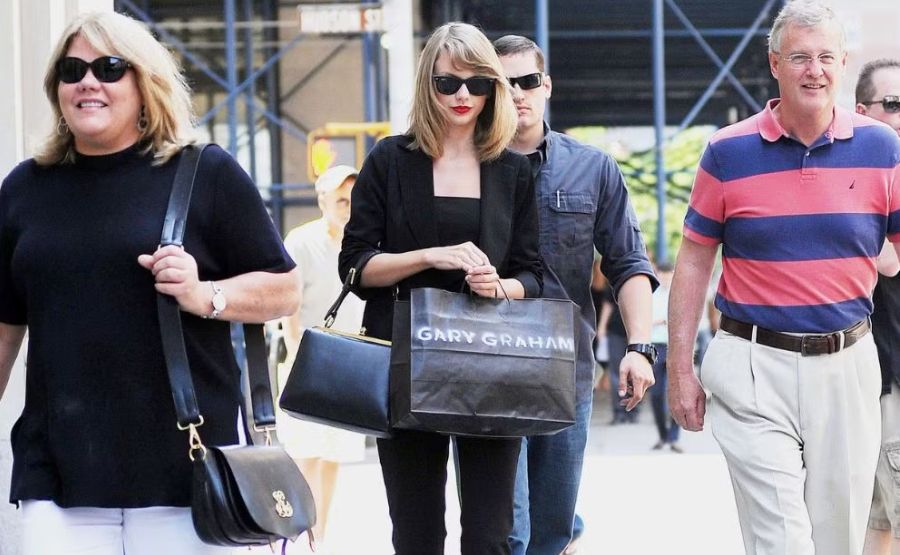
The Woman Who Ran the Show
Andrea Gardner Finlay grew up carrying two inheritances. One was practical: her father, Robert Bruce Finlay, was a structural engineer whose international contracts took the family to Singapore during Andrea’s childhood years. The other was artistic: her mother, Marjorie Moehlenkamp Finlay, was a trained coloratura soprano who toured South America, performed opera in Puerto Rico, hosted her own television program, and sang at a level that, in her granddaughter’s memory, made the church choir seem like background noise.
Andrea attended Memorial High School in Houston, Texas, then the University of Houston, where she studied and later began a career in mutual fund marketing. Taylor has described her mother in a single sentence that captures the contrast between them perfectly: “Mom is calculated, logical, business-minded; kind but very, very direct.” It is, in its way, a portrait of someone who could manage both a family and a nascent artist’s career without confusing the two.
Andrea was the one who encouraged Taylor to get health checkups in 2014. It was Andrea who insisted the appointment be kept. And the cancer diagnosis came about as a result of that appointment in late 2014 or early 2015; this is one of the minor but painful ironies of a life built around protecting the people she loved.
Before the diagnosis, Andrea had reinvented herself entirely. She stepped away from her marketing career to accompany Taylor on the road during the early years of her career. She sat in on songwriting sessions. She produced music videos. She scouted fan sections at concerts, handpicking dedicated audience members to attend post-show meet-and-greets. She became, in effect, the general manager of a pop empire, without ever holding a formal title or issuing a press release about it.
The Move That Changed Everything
The decision to relocate to Nashville was, on one level, Andrea’s. Multiple accounts identify her as the one who pushed hardest to make it happen, who recognized in her daughter’s talent something that would never survive half-measures, and who understood that the music industry required proximity.
By moving his book of business south, Scott made it feasible. The mechanics were his. The vision was hers.
Taylor was fourteen when the family arrived in Hendersonville. Within months, she had organized a showcase at the Bluebird Café that drew Scott Borchetta’s attention. Within two weeks of that concert, she had signed with Big Machine Records. The contract included a stipulation that she would write all of her own material — a condition that, in retrospect, would define her artistic identity for the next two decades.
Scott also purchased his stake in Big Machine around this time, writing a check that formalized the family’s investment in their daughter’s future in a way that was simultaneously paternal and transactional. He was not just a father in the audience. He was a shareholder.
The Big Machine Controversy and the Limits of Loyalty
The 2019 sale of Big Machine Records to Scooter Braun’s Ithaca Holdings produced one of the most publicly dissected disputes in contemporary music business history. Taylor’s response was raw and immediate. She called the sale her “worst-case scenario.” She described Braun as an “incessant, manipulative bully.” She announced plans to re-record all six of her Big Machine albums in order to reclaim ownership of her songs.
Scott’s position in this drama was structurally awkward. As a minority shareholder, he received notice of the pending sale in late June 2019. Scott Borchetta later stated that Swift family representatives were informed, participated in shareholder calls, and that the vote to approve the sale passed with a substantial majority. Taylor’s team responded that Scott had missed the relevant calls because the NDA governing the transaction was so restrictive that participation risked obligating him to deceive his own daughter.
Both accounts may be accurate. Families within business structures often face exactly this kind of bind — the shareholder’s obligations running directly into the parent’s loyalties. What is not in dispute is that Scott sold his stake when the label changed hands and reportedly realized a return estimated at $15 million or more on his original $300,000 investment. He made no public statement about the controversy. His daughter became the public face of the battle and eventually, in 2025, acquired the masters outright from Shamrock Holdings. The resolution was hers. The complexity of the preceding decade was shared.
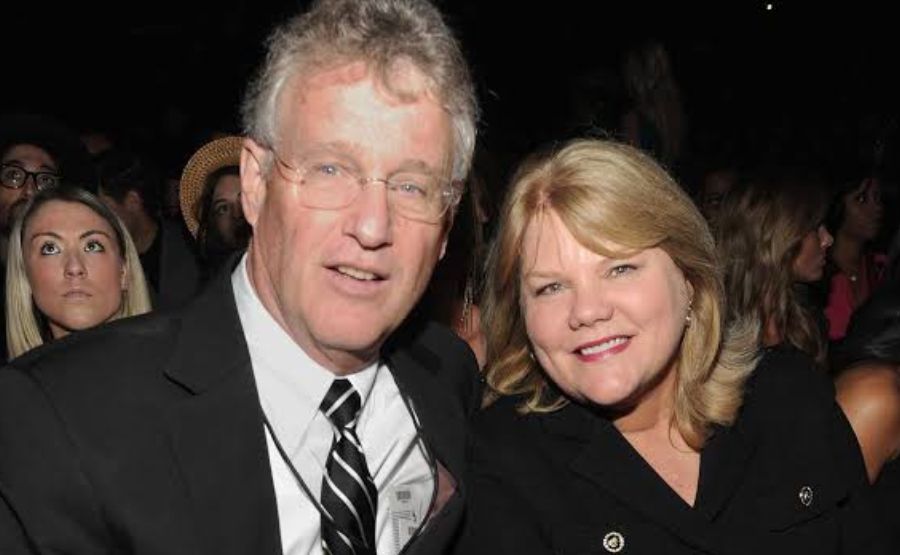
Two Diagnoses, One Decade
Taylor’s 2019 personal essay for Elle magazine contained a sentence that most readers absorbed quickly and then set aside: “Both of my parents have had cancer, and my mom is now fighting her battle with it again.” Scott’s cancer — the type and timing — remained private at his preference. Andrea’s was not, because Andrea wanted it public.
In April 2015, Taylor disclosed her mother’s breast cancer diagnosis on Tumblr in a message framed not as celebrity news but as public health advocacy. She wrote that Andrea “wanted you to know” so that Taylor’s audience might remind their own parents to get screened. The announcement was careful, restrained, and entirely characteristic of Andrea’s approach to her own illness: she would not hide it, but she would control the terms.
The cancer returned in 2019. During chemotherapy, doctors found a brain tumor. Taylor told Variety in 2020 that the symptoms of a brain tumor were categorically different from anything the family had experienced before — that this was territory none of them had maps for. She wrote “Soon You’ll Get Better” for her 2019 album Lover, a ballad so painful to perform that she has said publicly she does not know if she will ever sing it live.
Scott’s health crisis arrived differently. His quintuple bypass surgery in the summer of 2025 became public when Taylor mentioned it — not in a press release, but in the course of conversation, on a podcast. She moved in with him during his recovery. Austin and Andrea were by his side through the surgery. The family’s response to illness, across a decade of it, has been consistent: they go quiet, they close ranks, and they stay.
What Marjorie Left Behind
Andrea Swift grew up hearing her mother sing. Marjorie Finlay’s voice was not a domestic pleasure — it was a professional instrument, deployed in opera houses, on Latin American tours, in Puerto Rican television studios, and in a church pew where, by her granddaughter’s recollection, she and Taylor together “out-sang the choir.”
Marjorie died on June 1, 2003, in Reading, Pennsylvania, when Taylor was thirteen. The proximity of that loss to the family’s Nashville move — and to Taylor’s emergence as a professional — shaped what followed in ways that are difficult to separate. Taylor has said her grandmother was among her first inspirations. In 2020, she released “Marjorie” on the album Evermore, a tribute that included sampled recordings of Marjorie’s actual voice embedded in the musical track.
Andrea carried her mother’s musical sensibility into a business career and then into her daughter’s career management. The line between Marjorie’s soprano and Taylor’s songs about heartbreak and family runs through Andrea, who absorbed the musical inheritance and redirected it across a generation.
Personal Life and Private Struggles
Scott and Andrea Swift married on February 20, 1988, in Harris County, Texas. They had Taylor in 1989 and Austin in 1992. They lived on a farm that was both literal — fifteen acres of Christmas trees — and metaphorical: a childhood constructed around seasonal rhythms, outdoor space, and the kind of insulation from ambient celebrity that their daughter would later try, with limited success, to replicate.
They divorced in 2011, after more than two decades of marriage. The separation was quiet. Neither parent has addressed it in the press with any detail. Taylor bought her parents a $2.5 million Nashville mansion that same year — a gesture that contained, perhaps, some measure of gratitude for the years of sacrifice, and some measure of ensuring that the dissolution of their partnership did not become a source of instability for either of them.
What both parents have maintained, despite the divorce, is a visible and apparently genuine alignment around their daughter’s and son’s lives. They appear together at events. They collaborate in crises. Scott attended the Eras Tour’s opening night alongside family. Andrea travels globally to appear at Taylor’s concerts. Whatever they could not sustain between themselves, they have sustained in parallel.
Legacy and Influence Today
Scott and Andrea Swift are not peripheral figures in their daughter’s story. They are load-bearing walls.
The financial infrastructure of Taylor’s early career — the label stake, the Nashville relocation, the funding of showcases and songwriting sessions — was theirs. The emotional intelligence that runs through Taylor’s songwriting, her capacity for narrative empathy, her understanding of what an audience needs to feel — that was shaped at home, in the presence of a mother who was both businesswoman and music inheritor, and a father who approached every room as a potential relationship.
Andrea’s breast cancer advocacy, conducted through Taylor’s platform, reached audiences that medical campaigns struggle to reach: young women whose parents do not go to the doctor. The Elle essay Taylor wrote about her family’s health crises has been cited in public health circles as an example of celebrity influence deployed usefully. Andrea wanted it public for exactly that reason.
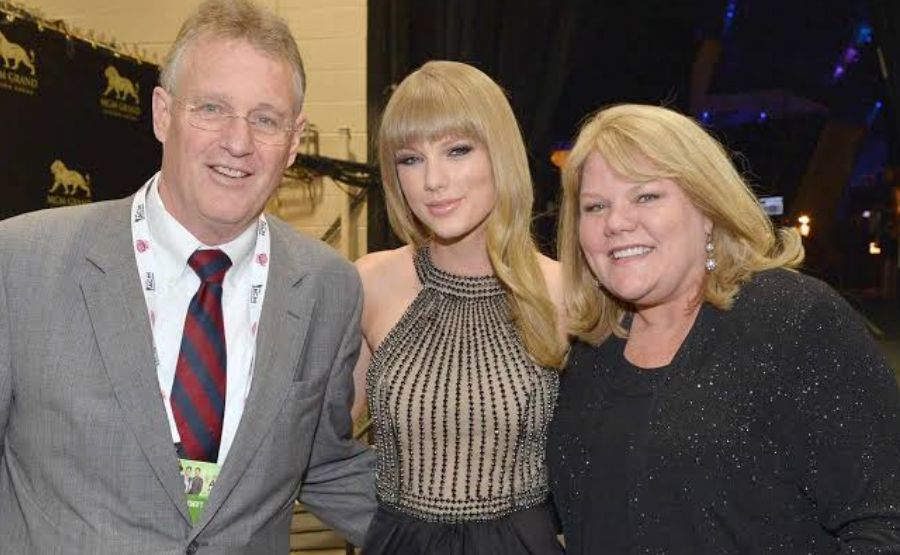
Scott’s role has grown quieter as Taylor’s apparatus has professionalized. He is less the financial architect now and more the constant presence: in the stadium seats, in the backstage photos, in the handwritten credential his daughter made for him. That evolution — from investor to cheerleader — reflects a renegotiation of their relationship that neither has described publicly, but that the photographs document clearly.
Final Words
Scott and Andrea Swift did not produce a famous child. They produced a specific kind of famous child — one who writes all her own songs, controls her own narrative to an unusual degree, maintains close family relationships throughout stratospheric fame, and responds to exploitation with strategic creativity rather than passive grievance.
That outcome was not accidental. It required a father willing to move a financial practice to a different city and to write a significant check into an uncertain investment. It required a mother willing to abandon her own career entirely, to sit in vans and venue green rooms and label offices, to become invisible in service of someone else’s visibility.
It also required, in the end, a degree of moral complexity. Scott’s stake in Big Machine Records placed him at an intersection of family loyalty and shareholder obligation that produced no clean resolution. His reported financial return from the sale was substantial. His daughter experienced the same transaction as a fundamental betrayal. That both things can be true simultaneously — that a father can act in a way that is commercially rational and personally painful — is one of the less romantic but more honest conclusions available about the Swift family story.
Andrea’s illness introduced a different kind of reckoning. She built her adult identity around managing her daughter’s public life. Cancer forced her to become, for stretches of time, someone who required management rather than providing it. Taylor’s response — the songs, the tour adjustments, the bedside presence, the public advocacy — suggests that the care was returned with interest.
Both parents, now in their late sixties and early seventies, remain in their daughter’s orbit. They are not parenthetical. They are continuing to write their portions of the story that the world has been reading for the past 20 years.
FAQs
1. Who are Taylor Swift’s parents?
Taylor Swift’s parents are Scott Kingsley Swift, a retired Merrill Lynch stockbroker and financial advisor, and Andrea Gardner Swift (née Finlay), a former mutual fund marketing executive. They married in 1988 and divorced in 2011.
2. Where did Scott Swift grow up?
Scott grew up in Bryn Mawr, Pennsylvania, into a family with a multigenerational background in finance. Prior to him, both his father and grandpa worked in the banking sector. In 1974, he received his degree from the University of Delaware.
3. What is Andrea Swift’s background?
Andrea was born in Pennsylvania and grew up partly in Houston, Texas, where she attended Memorial High School and later the University of Houston. Her mother, Marjorie Finlay, was a professional opera singer. Before turning her attention to helping Taylor achieve her musical goals, Andrea worked in marketing.
4. Why did the Swift family move to Nashville?
The family relocated to Hendersonville, Tennessee, in 2003 to support fourteen-year-old Taylor’s pursuit of a country music career. Scott transferred his Merrill Lynch practice to the Nashville office and Andrea fully committed to managing Taylor’s emerging career. Taylor has called the move something she will “never forget.”
5. Did Scott Swift invest in Big Machine Records?
Yes. When Taylor signed with Big Machine Records in 2005, Scott purchased a minority stake in the label, reportedly at three to four percent for approximately $300,000. That stake reportedly yielded returns estimated between $15 million and higher figures when the label was sold to Scooter Braun’s Ithaca Holdings in 2019.
6. Was Scott Swift aware of the Big Machine sale before it happened?
This was a central point of dispute. Label founder Scott Borchetta claimed Swift family representatives were notified and involved in shareholder discussions. Taylor’s team stated that Scott missed key calls because a strict NDA governing the transaction would have forced him to conceal information from his daughter. He did not participate in the final shareholder vote personally.
7. What illnesses have Taylor’s parents faced?
Andrea was diagnosed with breast cancer in 2015. The disease recurred in 2019, and during chemotherapy treatment, doctors discovered a brain tumor. She is a two-time survivor. Scott faced his own cancer battle, details of which he kept private. He underwent quintuple bypass heart surgery in the summer of 2025 and recovered with his family present.
8. How did Andrea’s cancer affect Taylor’s music?
It profoundly shaped several albums. The song “Soon You’ll Get Better” on Lover (2019) is a direct reckoning with Andrea’s illness — Taylor has said she cannot perform it live without breaking down. “Marjorie” on Evermore (2020) honored Andrea’s late mother, Marjorie Finlay, whose sampled voice appears in the recording.
9. Who is Marjorie Finlay?
Marjorie Moehlenkamp Finlay (1928–2003) was Andrea’s mother and Taylor’s maternal grandmother. A coloratura soprano, she performed opera and concert singing across the United States, Latin America, and Singapore, and hosted her own television program in Puerto Rico. She died in 2003 and was memorialized in Taylor’s song “Marjorie.”
10. Did Andrea Swift manage Taylor’s career?
Informally, yes. Andrea accompanied Taylor extensively during the early years of her career, attending label meetings, producing early music videos, and curating fan interactions at concerts. She was never Taylor’s official manager in a contractual sense, but functioned as a central organizing force during Taylor’s formative years in the industry.
11. When did Scott and Andrea Swift divorce?
They divorced in 2011, after more than twenty-two years of marriage. Neither has spoken publicly about the reasons. Taylor reportedly purchased a Nashville home for her parents that same year.
12. What role did Scott Swift play in Taylor’s Grammy win in 2008?
When Taylor won a Grammy for Best New Artist in 2008 — an award she later addressed as one she did not feel she deserved — she dedicated her award to her father from the stage, saying: “This is for all those times that you said I could do whatever I wanted in life.” The moment is widely cited as an illustration of the closeness between them.
13. What is the “D.O.H. Pass” reference?
Taylor gave her father a handwritten backstage pass that said “D.O.H.” for the 2023 Eras Tour’s first night. Pass (Dad of Headliner).” She posted a photo of it to Instagram, and the gesture became one of the more widely shared moments of her relationship with her father during the tour.
14. Did both Swift parents stay involved in Taylor’s career after her success?
Yes, in different ways. Scott has maintained a presence as a supportive figure, attending tours and appearing publicly at Taylor’s events. Andrea has been a constant presence at shows, famously meeting fans through post-show events, and her health battles have remained intertwined with Taylor’s public narrative. Austin Swift, their son, has also worked on some of Taylor’s film projects.
15. What is the broader significance of the Swift parents’ story?
Their story raises questions that matter beyond their family: about what parents owe to a talented child, what a child owes back to the parents who sacrificed for them, and what happens when a family’s financial and emotional interests become entangled with one of the most litigated disputes in the modern music industry. They represent both the possibilities and the complications of parents who go all in.
Discover more, learn every day, and fuel your curiosity with Daily Discover.