Emily Abraham: The Woman Who Built a Luxury Empire From Nothing
She lost her mother at six, slept on strangers’ couches at fifteen, and now presides over one of the world’s most trusted luxury resale brands — and what makes Emily Abraham matter today is not the Birkin bags, but the proof of concept she represents: that identity can be rebuilt from almost any starting point.
Quick Facts
| Full Name | Emily Abraham |
| Born | 1977, South-West England |
| Nationality | British (Hungarian heritage) |
| Religion | Islam (converted 2017) |
| Spouse | Adam Abraham (married 2018) |
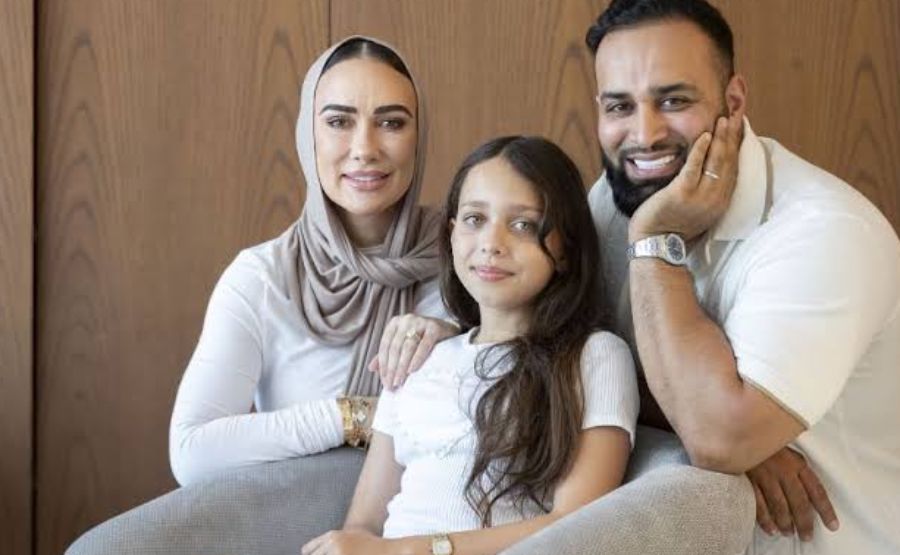
| Children | Five (three biological, two stepchildren); daughter Maali “Moo” is the most publicly known |
| Key Roles | Co-Founder & CEO, Love Luxury; Host, The Love Luxury Podcast |
| Major Locations | London (Knightsbridge/Beauchamp Place) & Dubai (Business Bay) |
| Known For | Luxury resale, authentication expertise, social media storytelling, “Birkin Queen” |
| Social Media | @therealemilyabraham on TikTok (160,000+ followers); Love Luxury Podcast (170,000+ Facebook followers) |
| Business Founded | Love Luxury, 2021 |
| Education | Studied nursing; trained in aesthetics/Botox |
The World She Was Not Supposed to Enter
Luxury was never written into Emily Abraham’s origin story. She grew up in the south-west of England in a household shaped by instability rather than affluence. Her mother was young and struggling; her grandfather, a gold trader, represented the family’s only connection to material value — though that wealth never filtered down to Emily or her mother.
When Emily was just six years old, her mother died. The cause was drug addiction. It is the kind of biographical detail that tends to define a person either as a victim or, retrospectively, as a catalyst — and Emily has consistently chosen the latter framing, without denying how devastating the loss truly was.
Soon after, she was placed in foster care. Her foster parents, including a woman she would later name publicly as Elaine, provided the stability and warmth that her earliest years had lacked. “Had I not been with you guys it would have been a very different story for me,” she told Elaine during a podcast episode years later — a rare and unguarded moment of gratitude that her audiences found deeply affecting.
See also ”Otelia Cox: The Quiet Force Behind the Spotlight”
A Childhood Education in Value
Before Emily Abraham ever appraised a Hermès Birkin or authenticated a Cartier bracelet, she was learning something more fundamental: how to distinguish the real from the fake, the valuable from the worthless.
Her Hungarian grandfather, a gold dealer, enlisted her as an informal apprentice during her childhood weekends. At around age seven, she untangled gold chains, sorted coins by carat, and began developing what she would later describe as a kind of instinctive eye for quality. This was not a hobby. It was a hands-on education in material discernment — one that no university degree would have replicated.
That early training seeded something lasting. It gave Emily an intuitive relationship with craftsmanship and authenticity that would later become the central differentiator of her business. When she holds a Rolex today and knows within seconds whether the movement is genuine, part of that knowledge traces back to a grandfather who saw something in a young girl that others around her perhaps did not.
The Years Nobody Saw
Between the foster care system and the Knightsbridge boutique lies a stretch of Emily’s life that does not photograph well: the years of survival, of improvisation, of working multiple jobs and sleeping on other people’s sofas.
She left home at fifteen or sixteen — accounts vary slightly — and entered a period of what housing advocates call “hidden homelessness.” She was not sleeping rough. But she was moving between the homes of others, dependent on the goodwill of acquaintances, living without the security that most teenagers take entirely for granted. She has spoken about this period not with shame but with a kind of clear-eyed honesty that her audiences find unusual and credible.
Her first formal job was at the deli counter of a Waitrose supermarket. She has recalled it with genuine pride. From there she moved into retail, then into healthcare — she studied nursing — and eventually into aesthetics and cosmetic treatments. For years she worked in the beauty industry, administering Botox and building a client-facing skillset that would later transfer, almost seamlessly, into the relationship-heavy world of high-end resale.
She also, during this period, entered what she describes as the buy-for-cash market: a fast, unglamorous corner of consumer trading where objects are assessed and priced in minutes, where negotiation is everything, and where trust is earned through accuracy rather than reputation. It was unglamorous work. It was also, in retrospect, essential preparation.
The Partnership That Changed Everything
In the mid-2010s, Emily met Adam Abraham. He was an experienced entrepreneur with a background in business operations. She was a woman with an eye for product, a gift for human connection, and a biography that had made her unusually resilient.
They married in 2018, and their differences became structural rather than divisive. Adam managed logistics, operations, and the scaling mechanics of a growing company. Emily handled product knowledge, authentication, customer relationships, and the brand’s public face. “What he’s really good at, I’m terrible at,” she has said. “What I’m really good at, he’s terrible at.” The division of labour was honest and deliberate.
Their courtship and early marriage overlapped almost completely with the construction of their business. In the nineteen months before Love Luxury launched, they spent nearly every waking hour together, rarely separated, entirely focused on building something neither of them had attempted before.
Building Love Luxury: The Noodle Years
In 2021, Emily and Adam Abraham launched Love Luxury from a boutique in Beauchamp Place, Knightsbridge — one of London’s most exclusive retail addresses. The timing was, paradoxically, almost perfect. The global pandemic had disrupted conventional retail, but the luxury resale market was in the middle of an unexpected surge. Consumers were reconsidering their spending habits, looking for investment-grade purchases, and gravitating toward sustainability.
The Abrahams were not the only people who saw the opportunity. But they brought something specific to it: a commitment to authentication that went well beyond industry norms, and a transparency in their communications that the sector rarely offered.
Every item sold by Love Luxury passes through independent, third-party authentication before it reaches a customer. The process is not cheap. Their accountant, Emily has said publicly, repeatedly suggested cutting those costs. They refused. In a market routinely troubled by sophisticated counterfeits, that refusal became their most powerful competitive advantage.
The early days were financially gruelling. Emily and Adam sold previous businesses and poured the proceeds into Love Luxury. There were no early dividends, no celebrations. They ate noodles for eighteen months, by Emily’s own description. When the funds for their Beauchamp Place fit-out ran short, she removed a watch from her wrist and handed it over to cover the gap. The luxury goods, for her, were always working capital — not identity.
They declined outside investment when interest came. Taking money, Emily explained on her podcast, meant ceding control. They chose autonomy over acceleration.
The Art of Authentication
Emily Abraham did not arrive at luxury resale already knowing everything. She built expertise through obsessive repetition, often staying awake until four or five in the morning comparing genuine and counterfeit items, studying stitching patterns, hardware finishes, leather grades, and the precise weight of fonts on dust bags and authenticity cards.
She learned how leather should smell. How a zip should feel under your finger. How Hermès hardware differs from a convincing replica in ways that take seconds to detect once you know them, and are almost invisible until you do. This was not glamorous work. It was painstaking, repetitive, and largely self-directed.
That obsession is now embedded in Love Luxury’s operational DNA. The brand’s reputation for trustworthiness — the thing that draws high-net-worth clients willing to spend six figures in a single visit — rests on an authentication process that Emily helped develop and still champions. She has become, in the industry, something of a reference point. The “Birkin Queen” tag was not one she sought. It arrived because she earned it.
Personal Life: Faith, Family, and Reinvention
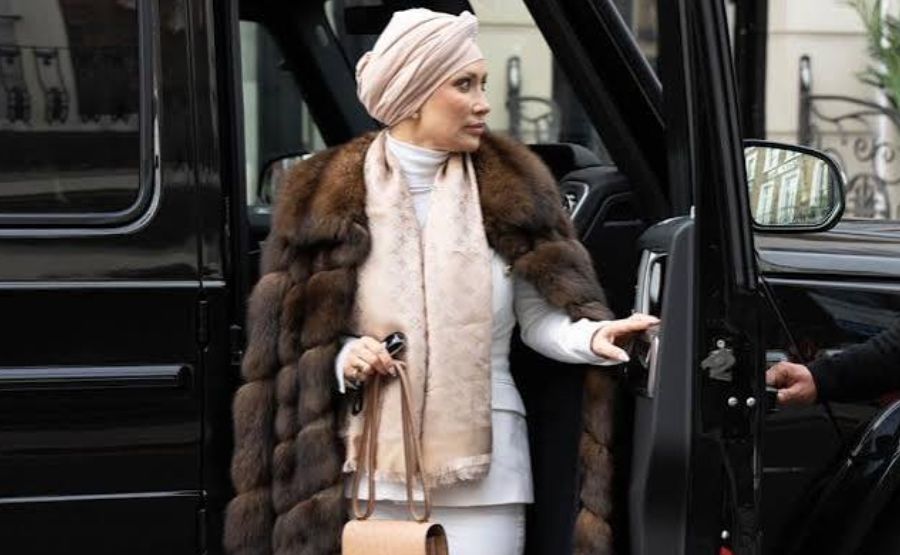
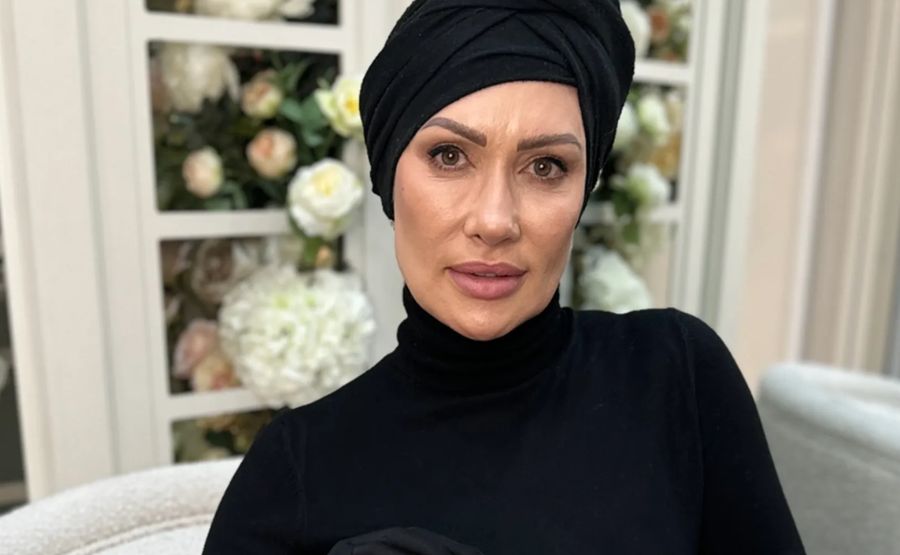
In 2017, Emily Abraham converted to Islam. She began wearing a headscarf, and the change was visible and public. She has discussed her conversion openly, framing it as a genuine spiritual decision rather than a social or relational one. It arrived before her marriage to Adam, who is also Muslim, and represented a private reckoning with identity and meaning that preceded — and in some ways shaped — the larger reinventions that followed.
Emily has three biological children from prior relationships and helps raise two stepchildren from Adam’s previous marriage. The family, now blended across five children, relocated to Dubai in connection with Love Luxury’s 2023 Middle East expansion. Emily lives there full-time; Adam moves between London and Dubai on a two-week rotation.
Her daughter Maali, known online as “Moo,” has become unexpectedly famous through the “Billionaire’s Daughter” video concept — short, playful clips in which Maali interacts with Love Luxury’s extraordinary inventory. The videos have accumulated millions of views and introduced the brand to audiences that conventional advertising would never have reached. Emily appears to take genuine delight in them. She is careful, however, to keep the identities of her other children more private.
On the question of wealth and lifestyle, the Abrahams have been notably candid. Adam has described reinvesting around ninety-five percent of earnings back into the business, with personal expenditure coming from the remainder. Charitable giving, he has said, comes before personal spending — a reflection of Islamic values of zakat that both he and Emily hold seriously.
The Podcast and the Platform
In 2023, Emily launched The Love Luxury Podcast, and what it reveals about her priorities is instructive. The show is not primarily about handbags.
Episodes have covered housing inequality, the structural invisibility of hidden homelessness, food poverty, domestic violence, and the importance of social support networks. Guests have included Chrissy Monroe from Love & Hip Hop, who founded the domestic violence charity Survive to Thrive Global, and Emily’s own foster mother Elaine. One episode featured Emily discussing her own experience of couch-surfing as a teenager — doing so on a platform that millions associate with opulent designer goods.
The juxtaposition is not accidental. Emily has described the podcast as a vehicle for reaching people through a platform she happens to have, and illuminating lives and issues that her audience might otherwise never encounter. It is one of the more unusual things about her public persona: a genuine willingness to use luxury’s attention economy to talk about poverty.
She is also candid about the costs of social media exposure. “You have to have a thick skin,” she has stated. “Negative comments are an inevitable part of having a large following.” She notes, without apparent self-pity, that the opinions of people she does not know do not unsettle her. Given her history, this is credible.
Dubai and the Global Expansion
In October 2023, Love Luxury opened a second location in Business Bay, Dubai. The move was both commercially logical and symbolically significant. The UAE luxury market is enormous, deeply established, and hungry for authenticated pre-owned goods. The Abrahams understood the appetite.
The Dubai expansion connected Emily to a global clientele — Gulf nationals, international collectors, investors treating pre-loved luxury goods as alternative assets. It also placed her within a media ecosystem that amplified her story to new audiences across the Arab world and beyond.
The family’s relocation to Dubai was not merely operational. It marked a new phase — of international identity, of a brand reaching beyond its British roots, and of Emily herself becoming something closer to a global figure than a local one.
Legacy and Influence
Emily Abraham’s influence operates on at least two distinct registers. On the first, she is a significant figure in the luxury resale industry — a sector that has grown from a niche market into a multibillion-dollar global business, and whose expansion has been shaped in part by entrepreneurs who understood, before most, that pre-loved did not mean second-rate.
On the second register, she functions as a kind of proof of concept for a particular kind of British social mobility — one achieved not through education, inheritance, or institutional support, but through perceptiveness, resilience, and a willingness to work obsessively at something until the work becomes expertise.
Her influence on younger women entrepreneurs, particularly those from disadvantaged backgrounds, is real and documented in the responses she receives from her audience. She is not a theorist. She does not deliver TED talks about resilience frameworks. She simply recounts, repeatedly and in detail, exactly what happened to her — the foster care, the sofa-surfing, the noodle dinners during the early business years — and allows audiences to draw their own conclusions about what is possible.
Love Luxury’s sustainability position also matters. The brand’s argument — that pre-loved is not a compromise but an ethical and financially sound choice — has helped shift the cultural conversation about consumption in the high-end market. That shift was underway before Emily and Adam arrived, but they have been among its most effective communicators.
Final Words
Emily Abraham is a genuine entrepreneur in the fullest sense: someone who identified an unsolved problem, built something to solve it, and refused to dilute the solution when it became expensive. Her insistence on authentication, on transparency, on organic growth over investor-driven speed — these are not marketing positions. They are structural commitments that shaped Love Luxury’s identity before the brand had an audience.
She is also a constructed public figure, and it is worth acknowledging that. The “Billionaire’s Wife” tag she has pushed back against, the viral videos with Moo, the podcast appearances — all of it forms a carefully managed personal brand that is inseparable from the commercial one. This is not a criticism. It is simply how modern consumer businesses operate, and Emily is better at it than most.
What distinguishes her, finally, is the refusal to pretend that the distance between where she started and where she stands today is ordinary. It is not. Most people who experience what she experienced at six years old, at fifteen, at twenty, do not end up owning boutiques in Knightsbridge and Business Bay. She does not explain this gap through talent alone or through luck alone, but through an accumulation of choices, many of them uncomfortable, made over decades.
That is a genuinely useful thing to put into the world. The Birkin bags are beautiful. The story behind them is more so.
FAQs
1. Where was Emily Abraham born?
She was born in 1977 in south-west England to a British father and a Hungarian mother.
2. What happened to Emily’s mother?
Her mother died from drug addiction when Emily was approximately six years old, which led directly to Emily entering the foster care system.
3. What is Love Luxury?
Love Luxury is a pre-owned luxury goods company co-founded by Emily and Adam Abraham in 2021. It specialises in authenticated handbags, watches, and jewellery from brands such as Hermès, Chanel, Rolex, Cartier, and Patek Philippe.
4. Where does Love Luxury operate?
The brand has two flagship boutiques: one in Beauchamp Place, Knightsbridge, London, and a second that opened in Business Bay, Dubai in October 2023.
5. How did Emily learn to authenticate luxury goods?
Largely through self-directed study — spending late nights researching, comparing genuine and counterfeit items, and building practical knowledge through repetition. Her childhood experience with her gold-trader grandfather also provided an early foundation in assessing material value.
6. When and why did Emily convert to Islam?
She converted in 2017, before marrying Adam Abraham. She has described it as a genuine spiritual decision, and she wears a headscarf publicly.
7. How many children does Emily have?
She has three biological children and helps raise two stepchildren from Adam’s previous relationship — five children in the family altogether. Her daughter Maali, known as “Moo,” is the most publicly known.
8. Did Emily and Adam take outside investment for Love Luxury?
No. They considered it and declined, preferring to maintain full control over the business’s direction and decision-making.
9. What is “The Love Luxury Podcast”?
A podcast Emily launched in 2023 covering topics beyond luxury goods — including homelessness, food poverty, domestic violence, and social inequality — alongside conversations about the luxury resale industry.
10. What does “Birkin Queen” mean in relation to Emily?
It is a nickname she has acquired in the luxury resale community, reflecting her particular
expertise in authenticating and trading Hermès Birkin bags — among the most valuable and counterfeit-vulnerable items in the market.
11. Is Emily Abraham active on social media?
Yes. She maintains a TikTok presence (@therealemilyabraham) with over 160,000 followers and is active on Instagram. The Love Luxury Podcast Facebook page has over 170,000 followers.
12. How does Emily describe her financial philosophy?
She and Adam reinvest the overwhelming majority of earnings back into the business, prioritise charitable giving as a religious obligation, and have spoken openly about living modestly during the company’s early years.
13. What was Emily doing professionally before Love Luxury?
She worked in the beauty and aesthetics industry, including as a practitioner administering Botox, and was also involved in the buy-for-cash market — trading second-hand goods — which gave her foundational knowledge of pricing and demand.
14. Did Emily experience homelessness?
Yes. After leaving home in her mid-teens, she experienced what she describes as “sofa surfing” — moving between others’ homes without a stable address. She has discussed this publicly on her podcast and in media interviews.
15. What is Emily’s approach to dealing with criticism online?
She has stated directly that the opinions of people she does not personally know do not affect her, and that a thick skin is a prerequisite for anyone with a significant public presence.
Discover more, learn every day, and fuel your curiosity with Daily Discover.